Showing posts with label Evolution. Show all posts

Tuesday, April 26, 2022

Punk eek 2

(cont'd from yesterday's post)

Here's a giant question for Darwin's theory: if all today's animal species very slowly and gradually evolved over millions and millions of years from other species, one small change at a time, then where are the fossils of those intermediate forms?

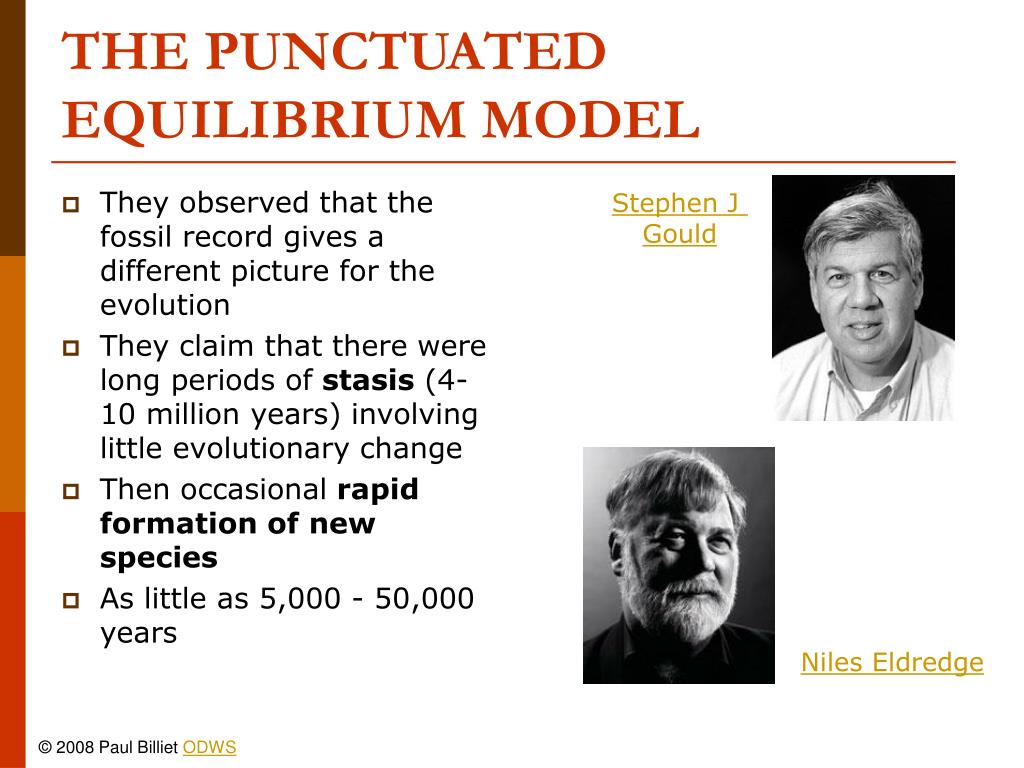
Paleontologists (fossil scientists) Gould and Eldredge tried to come up with an answer to this question because of "their honest recognition that the countless intermediate forms which should be expected from evolutionary theory are simply not there."

Yesterday's video about punctuated equilibrium really got into the weeds, too much information. But here's a summary.  The paleontologists' explanation was that evolution didn't happen gradually, but rather fast and between long periods of stasis. So fast, in fact, that all those intermediate forms between species didn't leave fossils! 

Before he died, Gould abandoned his punk eek theory.

from Evolution News

Monday, April 25, 2022

Punk eek 1

(cont'd from this post)

Many in the field of science, mathematics, technology, education have gone all in for Darwin's theory of evolution (all living things evolved in a long line of inheritance from the first living cell, depending on how their varied inheritance affected their survivability).

But the big problem with this theory is that the fossil record mostly doesn't show a history of species changing into different species, which you would need. Scientists who want Darwin to be right in spite of the fossil evidence try to think of ways it could still be true.

The next example of scientists trying to help Darwin's theory is a theory called "punctuated equilibrium" or "punk eek."

from Evolution News

Friday, March 25, 2022

Help Darwin 2

(cont'd from yesterday's post)

Despite the lack of much evidence from the fossil record, some scientists wanted to find a way to make sense of Darwin's theory of macro-evolution (that all species of life developed by way of natural selection working on random variations, not by the work of a Designer). 

Charles Darwin himself had a suggestion. When he published the book (1859), he knew that most of earth's fossil record had not been investigated yet. So he suggested that future fossil research would reveal those slowly evolving animal forms in between species. They had to be there.

But another 163 years of paleontological progress since Darwin's time has found that . . they are not there. Species do evolve in the sense of minor changes over time. (That's micro-evolution and it's been observed. It is not disputed.) But innumerable intermediates forming a gradual trail of animals turning into other species since life began? No.

For more attempts to get around the fossil problem that worried Charles Darwin, view yesterday's video or go here.

Thursday, March 24, 2022

Help Darwin

(cont'd from this post)

Charles Darwin was worried about the fossil record because it didn't show innumerable intermediate forms proving super gradual change into today's living animals. He still wanted his theory to be true, in spite of the evidence of twenty new types of animal bodies in the Cambrian era which show up in the fossil record suddenly with no forms leading up to them.

Some scientists went to work to help find a way that the theory could still be true in spite of evidence from the Cambrian Explosion fossils.

Friday, March 18, 2022

Darwin doubted 2

(cont'd from yesterday's post)

"Did you know that Charles Darwin knew about the key issue in his theory that doesn't add up? Did you know that he was troubled that an entire field of scientific study opposes the key tenets of evolution?"

So starts the video in yesterday's post. This man of faith's purpose, he says, is to challenge skeptics, strengthen believers, and create a space for awesome discussions about God. He's making the case for intelligent design

Today, conventional science and culture are dominated by a naturalistic paradigm which says that there is no divine designer or Creator God, and that all life forms developed according to Darwin's theory of (macro) evolution. So it's assumed that all opposition to this version of evolution must come from religious dogma or superstition.

But it's not so today, and it was not so in 1859. Leading paleontologists in Darwin's day would not adopt his theory because the whole field of paleontology painted a picture opposite to that which would have supported his theory. There should have been "innumerable" examples of animals in slow, gradual transition throughout the fossil record. But, on the contrary, new and complete body structures appear in the fossil record suddenly - without evolutionary precursors. (It's all in yesterday's 12-minute video.)

Thursday, March 17, 2022

Darwin doubted 1

Charles Darwin published a game-changing book, The Origin of Species, in 1859 to explain his theory about how all species of life originated. It challenged the era's conventional wisdom which said that the Creator God specially designed each type of creature. 

Darwin claimed that all life of every type descended from one unknown original life form, changing gradually through its generations. When a change (variation) helped a life form to survive and reproduce, there were eventually more of this variety of plant or animal life. This happened countless times, slowly and gradually changing generations of life forms over enormous time spans, resulting in all the species of earth's history. 

Certainly species change (micro-evolution) over time by a process (natural selection working on variations) which is undisputed today. But could this process have produced all the different species of life on earth (macro-evolution)? That is far from proven, and it is disputed.

Darwin was not cocky about his theory. He had doubts, and was humble enough to admit them.


(cont'd tomorrow)

Wednesday, February 23, 2022

Algorithms 3

(cont'd from yesterday's post)

Looks like these animals have (in their tiny brain?) a set of sequenced instructions that lead to a prescribed outcome. That's an algorithm, similar to a recipe. Every computer program is based on algorithms.


When people navigate, they choose a destination and a method of finding their way - a paper map, or verbal directions, or gps, or a computerized guidance system built into the aircraft or seagoing vessel. All of these were developed with difficulty over many years of history, most recently by people with math and computer science degrees. 

We're sure not born knowing how to get to New York or anywhere else. But animals are born pre-programmed with goals and algorithms. It looks like the product of an intelligent, intentional design.  Does it prove the existence of the Creator? No, it's not proof. It is strong supporting evidence. 

The more we learn, the harder it is to assume that all life resulted from mindless, random, unplanned, undirected chance. See Charles Darwin's statement in yesterday's post.

from Mindmatters

Tuesday, February 22, 2022

Algorithms 2

(cont'd from yesterday's post)

Monarch butterflies and salmon navigate thousands of miles. In fact, the butterflies require three generations to get to their destination. How do just-born butterflies know they all must complete this journey, know how to do it, know when and how to return? 

Animals use methods that human beings eventually worked out for ourselves, like dead reckoning, sun polarization, spherical geometry and path integration. Animals keep track of their position and the distance they've gone with some program in their tiny brains. Humans use millions of lines of computer code to program similar navigation.

Genetic inheritance is easy to understand if we're talking about the color of a bird's beak, or something like that. But . . what about a command to fly to a certain location in Mexico? Or instructions on how to get there, not on roads but in mid-air? 

Charles Darwin couldn't explain this sort of in-born behavior in animals within his theory of evolution. In his Origin of Species he said that instincts are such a mystery that their origin would strike many “as a difficulty sufficient to overthrow my whole theory.”

from Mindmatters

(cont'd tomorrow)

Friday, August 9, 2019

Darwin failed 3

(cont'd from yesterday's post)

David Gelernter says that Darwinism is central to the modern worldview, that accepting it as settled truth is "an essential first step towards being taken seriously in any part of modern intellectual life." He speaks of what he knows, as a professor at one of America's most prestigious universities.

Now he has publicly revealed that he believes Darwin was wrong about the origin of species. In the Yale environment, he is attacking the religion of his friends and associates.

Though he likes his colleagues, when he looks at "their intellectual behavior, what they have published [and] what they tell their students — Darwinism has indeed passed beyond a scientific argument as far as they are concerned. 

"You take your life in your hands to challenge it intellectually. They will destroy you if you challenge it.”

Thursday, August 8, 2019

Darwin failed 2

(cont'd from yesterday's post)

David Gelernter starts out his piece, "Giving Up Darwin," by saying "Darwinian evolution is a brilliant and beautiful scientific theory." He wants to give Charles Darwin full credit for his "astounding" idea as described in The Origin of Species, published 1859. 

There's no doubt that species adapt to circumstances  - evolve - in small ways like fur density, but the origin of species is exactly what evolutionary theory cannot explain. The professor cites two lines of argument that convinced him of this.


1)  The "Cambrian Explosion" refers to the fossil record which shows new animal body plans emerging about half a billion years ago. According to Darwin's theory, these newly appearing animals should have very gradually appeared in history, with many transitional forms before them. But their transitional forms don't exist in pre-Cambrian fossil layers. The new animals exploded into history.

2)  New animal forms, i.e. new species, would require new animal-building instructions within cells. Since Darwin's theory came out (1859), molecular biology has revealed that random mutation cannot account for new proteins and DNA. Anyone of his day would have been utterly ignorant of this.


(cont'd tomorrow)

Wednesday, August 7, 2019

Darwin failed 1

At Yale University there's a computer science professor, David Gelernter, who "is known for predicting the World Wide Web and has developed many complex computing tools over the years . . ."

Not a lightweight, he was called "one of the most brilliant and visionary computer scientists of our time" by the founder of Sun Microsystems.


He apparently thinks for himself (see last Friday's post) - which is surprising, because his work environment demands conformity. Diversity of race, gender, etc., is celebrated, but diversity of thought is out of line in the academic world.

Official dogma in the university world is Darwinism: the belief that all life on earth came about through natural selection and random genetic mutations.  A few think maybe God had a hand in it ( i.e. theistic evolution) but they are insignificant in that world.

Yet David Gelernter published an article in May entitled, "Giving Up Darwin." His conclusion is that "Darwin has failed."

(cont'd tomorrow)

Wednesday, July 31, 2013

Evolution in fossils

(cont'd)

So macro-evolution claims that all forms of life we see on earth today could be theoretically traced back through their millions of evolving ancestors to one living cell that appeared somehow about 3.8 billion years ago.

Picture what that would look like if we could see those fossil remains.  Try to imagine layers of rock showing sea worms with a bump on their lower side, then rocky layers of fossils with two bumps, then fossils of worms with three bumps with a division of toes, then fossils with one true leg, then a layer of fossils whose legs have toes, then fossils of worms with four legs and claws, then fossils of legged worms with lungs instead of gills (wait - that's huge genetic change), then lizards with eyes feet and lungs, then . . .

You get the idea, picture innumerable slight variations leading to elegant organs like lungs and eyes and to wildly differing life forms.  This was Darwin's vision of what he expected would be found in the fossil record.  But the fossil record doesn't look like that.

Instead, what scientists have discovered (in the 150+ years since Darwin's book) is a fossil record that shows this:   the sudden rather than gradual appearance of animal/plant species, and usually stable body design which does not morph into other designs.


photo:  pe.com

Tuesday, July 30, 2013

Macro-evolution

(cont'd)

Survey after survey shows that Americans largely do not believe that last meaning of  "evolution" is correct. But public (government) schools, from elementary to university level,  uniformly teach that it is correct.

Both public schools and government are committed to avoid supporting any view whatsoever that involves God, so their options are severely limited.  There's only one theory about the origin of life that doesn't involve God at all, and that is evolution (see the third meaning of this word, macro-evolution, in yesterday's post).

Here's how it works.  Offspring retain the characteristics of their parents almost entirely, but random small variations can occur.  Among all the offspring, if an individual has an advantageous variation, then that individual may have more offspring bearing the inherited advantage. Over time, the species evolves in that direction, resulting in new life forms.

It's called natural selection.  The individuals in every generation who survive to reproduce were the most fit to survive and reproduce.  Nobody disagrees with this!

There is only disagreement with the claim that this process alone produced all life's diversity:  whales, spiders, palm trees, cats, tulips, dinosaurs, butterflies, wolves, roses, salmon, worms, moss,  etc., etc.

photo:  statedclearly.com

Monday, July 29, 2013

What is evolution?

The word is often used, and its meaning can be pretty fuzzy.

First there is the general meaning which no one argues about:  just change over time.  In this sense, you evolve as you learn and experience life; your job evolves as you add or subtract responsibilities.  Change occurs in almost everything as time goes on.

Then there is micro-evolution, which no one argues about:  all life species change somewhat in relatively minor ways.  The size of a bird species' beak can change with changing circumstances, for instance, so that most of the birds in an environment have stronger/bigger beaks when the seeds available to eat become tougher.  An apple is developed by horticulturists that is sweeter and juicier than others.

photo:  mrjacksfarm.com

But it's the third type that does get argued about:  macro-evolution.  This theory says that changes in a kind of animal/plant happen over generations to the point that the later animal/plant is actually a different kind than its ancestors were, and all the kinds of life on earth came about this way.

There are lots of implications to this meaning of evolution.


Tuesday, January 8, 2013

Disappointment for evolutionists?

You probably know that your genes are found in the super big and complicated molecule called DNA in the nucleus of all your cells.  You may know that those genes are coded with instructions for making all the types of proteins (there are hundreds) which your cells need in order to operate.

You may not know that only about 1% of your DNA actually carries those protein-building instructions.  There are long stretches of DNA segments that do not code for proteins.  For years biologists have called these segments "Junk DNA", thinking they were useless.

The teaching of evolutionists goes like this:  If God created DNA, he would certainly not have included  worthless junk in his design.  It can only be that "Junk DNA" developed during millions of years of evolution, their usefulness eventually ended, and they became retained residue of the evolutionary process.

Big surprise!  A huge research effort has found that about 80% of our DNA is not junk but instead has important, even vital function.

Are scientists upset?  No, not if they hold their assumptions lightly and are willing to go wherever the evidence leads.  Yes, if this new information threatens their assumptions and their convenience.

Watch this two-minute summary by biochemist Fazale Rana:

 http://www.youtube.com/watch?v=BqcgM9cGxik

Sunday, January 6, 2013

We don't completely buy it


"Seventy-eight percent of Americans today believe God played some role in how people came to exist, while only 15% attribute it to evolution alone"

Read more: http://www.nydailynews.com/life-style/americans-reject-evolution-creationism-poll-article-1.1090596#ixzz2HFm4Z1t0


What! Most people think God had a hand in the origin of humanity?  If you think evolution (chance mutations acted upon by natural selection) is sufficient to explain human life, with no interference from God, you are in the small minority.  Surprising, because . . .

Public schools K-12 and beyond have taught for decades and decades that evolution is the total answer to how we got here.  But somehow most people are not buying it.  How can that be?

It's frustrating to evolutionary scientists and profs and teachers.  They think they just need to improve their teaching methods.

Maybe it's something else.  Everyone knows that the Bible teaches that mankind is made in God's image. Maybe there's an intuition built into the human mind that can discern God's involvement in creation.


Here's the article where this idea is developed:
http://www.reasons.org/articles/articles/intuitive-knowledge-and-the-image-of-god-part-4-of-4